
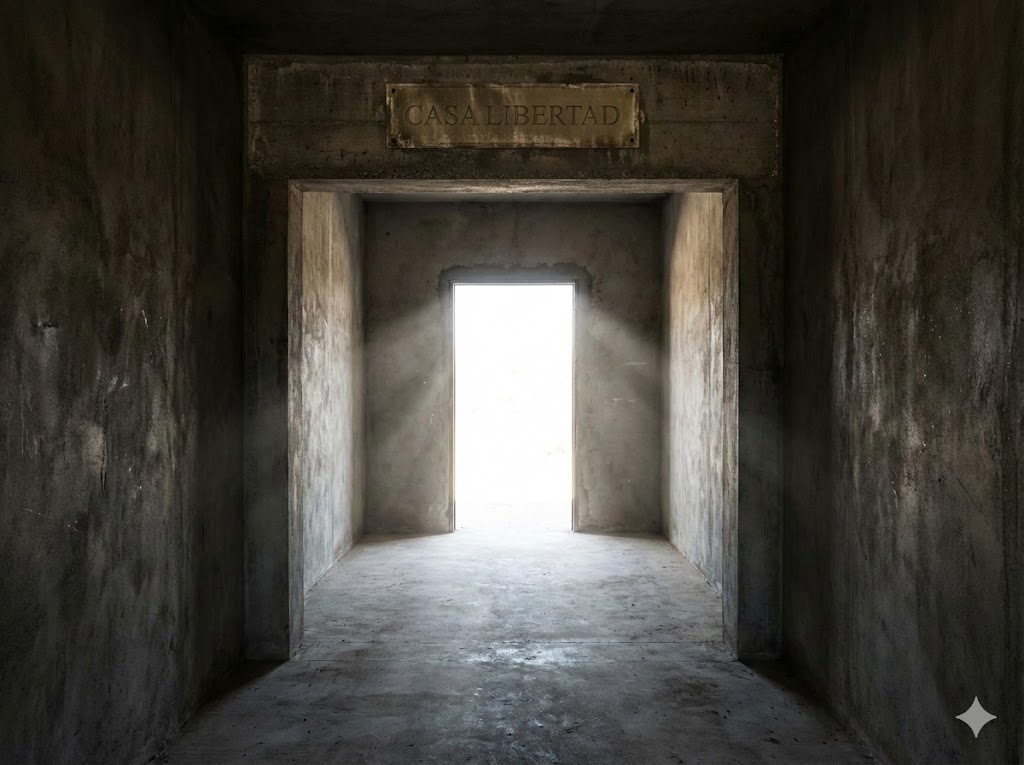
GRADUATION PROJECT To opt for the Baccalaureate degree in Interior Design & Decoration
Under the Theme: Disruption and Resilience
DISRUPTION AND RESILIENCE Design CASA LIBERTAD Temporary shelter for victims of human trafficking. Association: Face of Justice
Heredia, March 2016
Gentlemen
Members of the Final Graduation Project Committee
Present
Dear Sirs,
I hereby make a formal request to submit the Graduation proposal in accordance with the Regulations of Final Graduation Projects of the Universidad Latina, Heredia Campus, as a basic requirement to start the Graduation process, to opt for the Bachelor’s degree in the career of Interior Design and Decoration, Prepared by:
Karina Monge Sandí
Identity Card: 113560021
The chosen research topic is entitled:
DISRUPTION AND RESILIENCE
Redesign CASA LIBERTAD
Temporary shelter for victims of human trafficking.
Legal Representative Association: Face of Justice
I propose as tutor the MSc. Susana Araya Ramírez
Pending the review and evaluation of the preliminary draft presented, as well as the observations of the case, it is cordially subscribed,
Heredia, March 2016
Gentlemen Members of the Final Graduation Project Committee
School of Interior Design and Decoration
Universidad Latina, Heredia Campus
Dear Sirs,
Under the faith of the oath, I declare that this work is of my own authorship and that in it I have not reproduced as if they were mine, totally or partially, books or documents written by other people, printed or not, but I have highlighted in quotation marks the transcribed texts and I have recorded the data of the author and his work.
Cordially subscribes,
Karina Monge Sandí
Identity Card: 113560021
TRAFFICKING IN PERSONS: From a historical, social and human rights perspective.
– GLOBAL VISION:
HUMAN TRAFFICKING
Map with country rating, field analysis.
– LATIN AMERICA
– COSTA RICA

The history of humanity is witness to the oppression, cruelty, violence of those who are strongest and most powerful towards the weak and vulnerable.
The narratives remain in the memory of entire peoples with stories of slavery of the oppressed, who often fought for their freedom, and became survivors, while others had a life of suffering and torture until their death. As time goes by, there are those stories that move and teach the truth about the value of the human being, to inspire the struggle for a more just society.
Human trafficking is classified as modern slavery, as it violates the dignity and freedom of the individual.
more slaves at any point in human history.
Through threats, the use of force, deception, abduction, fraud or abuse of power, victims are caught and exploited physically, psychologically, financially by traffickers. adfadtrasuttratreaters psychologically, financially by their
Many people think that the phenomenon of slavery has been eradicated, but there are more slaves today than at any point in human history. According to the International Labour Organization, there are “almost 21 million people who are victims of forced labour: 11.4 million women and girls and 9.5 million men and boys.
Forced labor commonly occurs in the sectors of “domestic work, agriculture, construction, manufacturing and entertainment” (..) adopting different forms of slavery. “the weakest victims are women and girls forced into prostitution, migrants trapped in debt bondage schemes, clandestine workers, all illegally,” (…) “Migrant workers and indigenous peoples are particularly vulnerable to forced labour.” ILO, (2016)
The history of humanity tells how entire civilizations were at the mercy of conquerors, who determined the exploitation or extermination of the dominated peoples. Will, decision, opinions, and feelings were freedoms suppressed by those in power. In 539 B.C., in the Babylonian empire, Cyrus the Great issued a decree that would forever change the course of humanity. “He freed the slaves, declared that all people had the right to their own religion, and established racial equality.” Human Rights (2016). Since then, this ideology spread rapidly, in Greece, India and the Roman Empire; they supported natural law, and the continuous struggle against those who were in power. Later, with the independence of the United States, it was declared that all men were made equal and the French made a revolution by proclaiming their natural rights. The discussion of rights became a recurring theme in European governments, and they joined forces to overthrow anyone who imposed themselves.
Through threats, the use of force, deception, abduction, fraud or abuse of power, victims are caught and exploited physically, psychologically, financially by traffickers. adfadtrasuttratreaters psychologically, financially by their
Documents guaranteeing human rights were drafted and disseminated throughout Europe. However, it seems, these European empires did not regard the people of the rest of the world as worthy of rights, and proceeded to colonize and exploit new worlds. Gandhi in India, protested that everyone on earth had rights and managed to get the Europeans to agree to a pact. Even so, two world wars motivated by xenophobia occurred.
Today, human rights are understood as those freedoms guaranteed by the fact of being a person: man, woman or child. Like living free, being treated fairly and expressing one’s opinion. These universal rights are listed in the United Nations Universal Declaration of Human Rights established in 1948.
Article 4:
NO ONE SHALL BE SUBJECTED TO
SLAVERY AND THE SLAVE TRADE ARE PROHIBITED IN ALL THEIR FORMS.
The importance of this Declaration and the great effort made to establish human rights can be appreciated. However, the phenomenon of human trafficking allows us to realize that there is still a lot of work to be done in the fight to achieve these rights for all people. In the 21st century, statistics are increasing every year with respect to hunger, poverty and social inequality. These factors make people vulnerable to slavery, in the search for better living conditions and corruption, as well as the impunity of transnational crime tolerate the activity.
The crime of trafficking in persons was recognized as such in December 2003, based on the Protocol to Prevent, Suppress and Punish Trafficking in Persons, Especially Women and Children, supplementing the United Nations Convention against Transnational Organized Crime. International government entities addressed this problem by participating in the Convention against Transnational Organized Crime in Palermo, Italy. By the fifteenth anniversary of the Palermo Protocol, 166 countries have joined, and have implemented the paradigm of prosecuting traffickers, protecting victims, and preventing crime through the implementation of laws. (U.S. Department of State, 2016)
Human Trafficking
“The action of recruiting, transporting, transferring, harbouring or receiving persons,
by resorting to the threat or use of force or other forms of coercion, abduction, fraud, deception, abuse of power or a position of vulnerability or
the giving or receiving of payments or benefits to obtain the consent of a person having authority over another for the purpose of exploitation. Forms of exploitation include, but are not limited to:
The exploitation of prostitution, prostitution of others or other forms of sexual exploitation,
forced labour, slavery or practices similar to slavery, servitude or
organ removal.” UNODOC (2016)
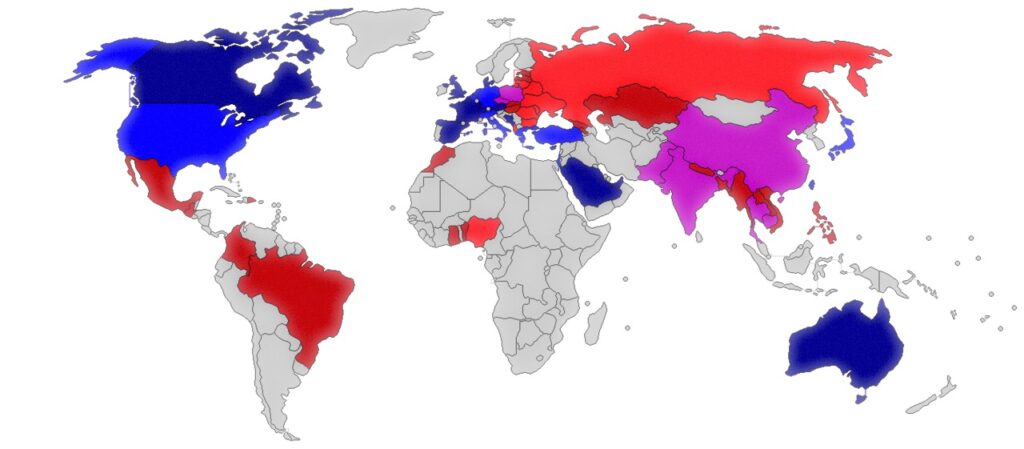
Source: abolitionseminar, (2014)
As is evident by definition, trafficking in persons is an international crime that violates the human rights of the individual and affects many countries in the world, whether as a point of origin, transit or destination. This map shows the countries of origin in red, and the countries of destination in blue.
These people are illegally traded for the purposes of “sexual exploitation, forced labor, child begging, or organ removal” by traffickers who resort to “recruiting, transporting, transferring, harboring, or receiving people.” Using “force or other forms of coercion, abduction, or fraud, deception, abuse of power or a position of vulnerability.” UNHCR. UNHCR (2016)
Commercial sexual exploitation, women victims.
“4.5 million of these victims are trafficked for the purpose of commercial sexual exploitation, 55 percent of all trafficking victims and 98 percent of sex trafficking victims are women and girls.” (…) “Human trafficking is considered a gender crime.” Exodus Cry (2016)
The discussion of trafficking in women for the purpose of commercial sexual exploitation was frequent due to the increase in transnational female migration. “The incidence of this phenomenon was recurrent in almost all regions of the world, and in various modalities.” IOM (2006)
The terms “trafficking in human beings” and “migrant smuggling” are used synonymously, but refer to different concepts. The objective of trafficking is the exploitation of the person, the purpose of trafficking is the illegal entry of migrants. In human trafficking, victims do not necessarily cross borders to constitute a crime. This element is of utmost importance to the traffic commission. IOM (2006)
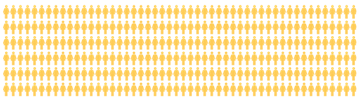
Never in the history of humanity have there been so many slaves as there are today. Author Kevin Bales estimates it’s $27 million. During the transatlantic slave trade, 12,500,000 African slaves were transported to the New World over 300 years. Currently, they are more than double.
The sale of slaves at that time was legal, today it is illegal. However, public auctions today are replaced by organized crime networks, of human traffickers. Before, only people with a lot of money could buy slaves, today slaves are more accessible, they work until they die or are abandoned, the author Bales calls today’s slaves disposable people. The Abolition Seminar (2014)
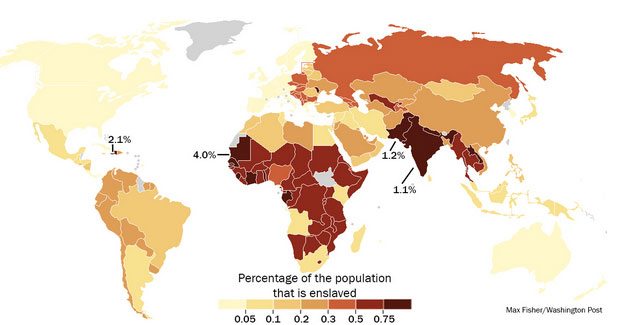
Percentage of the population enslaved.
Source: justiceforyouth (2013)
Beyond the numbers, the intention of this analysis is to delve into the reality of those in bondage. People with whom the world is shared. The intention is to stop seeing them as someone else’s business, with a negative connotation of defenseless victims.
This essay seeks to share the personal experience in that meeting of exchange of stories, to understand what happens to them, without denying the unfortunate reality of an unjust society that ignores them. By exposing the facts, it seeks to appeal to this social problem that actually affects everyone.
To achieve this approach, photographs by Silvia Grav are included. This Spanish artist manages to capture in a very particular way through photography that “beauty in the depths of existence”. Montoya (2016)
His work is impressive, as he manages to subtly evoke sensitivity, feelings of pain, fear, anguish, sometimes giving flashes of hope and light. These emotions are experienced day by day by those caught up in the sad reality of modern slavery, although they are probably already used to living this way. With compositions in high contrast, mostly black and white, this artist plays with light, capturing emotions and activating our unconscious. “Inviting us to walk through a labyrinth of dreams.
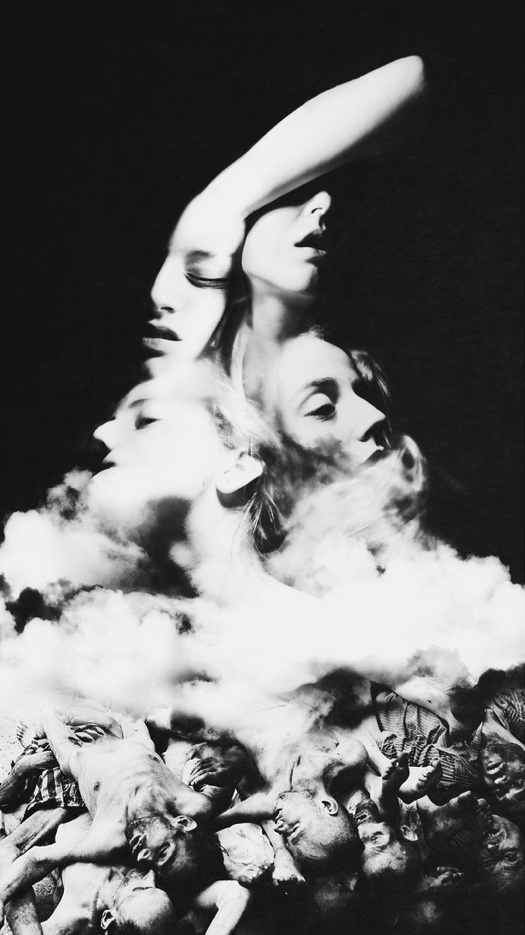
“Holocaust”, Grav (2016)
“The murky magic of his photographs is so special that it hurts, it is so disturbing that it scratches, caressing the intricacies of being”
Rocío Montoya (2016)
Each year, the U.S. Department of State develops the most comprehensive global guide to government efforts to confront and eliminate human trafficking.
The actions of the governments of 188 countries and their anti-trafficking reforms are qualified to identify prevention, protection, and prosecution resources.
-It also includes more assistance to victims and a decrease in evidence of corruption by government officials.
-It is determined, based on the commitments of the countries, to make significant efforts compared to the previous year.
Level 3: Countries in which the government does not meet minimum standards and is not making efforts to achieve it.
vinar dapibus leo.
International organizations, foreign governments, and non-governmental organizations use this report as a reference, and at the same time it illuminates and empowers activists in the fight against the human trafficking industry on all continents.
The author was confronted with social injustice through a visit by a photographer in a university course. Susi Childers was developing a book project, “Voice for the Voiceless.” It included powerful photographs she had taken around the world of vulnerable people and their stories. Months later he had the opportunity to visit India and China, and it was there that he saw the faces behind the numbers of the statistics.
She visited orphanages for abandoned children, leper communities, and met young girls in the harsh reality of prostitution. Their stories moved her and she was able to understand a whole context and social conditioning, which keep these people in cycles of exploitation. Since then she has continued to research, attending conferences and congresses on prostitution and human trafficking and actively participating in anti-trafficking initiatives and projects.
Below are reference maps with their respective ratings for each country, according to the State Department report, in relation to human trafficking in 2015. I also include some data on a specific country in the region evaluated in relation to the experience in the cultural environment.
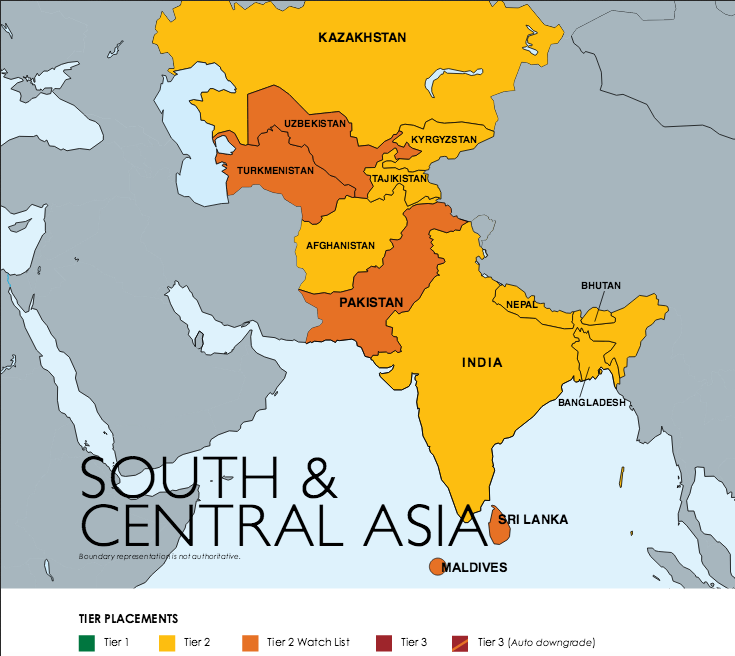
Map: Rating of Anti-Trafficking Efforts in Central and South Asia. Source: U.S. Department of State. (2015)
In India, there is a social order derived from Hinduism, which classifies people by caste. According to Hinduism “human beings were created from the different parts of the body of a god called Brahma” from these parts of the body are classified the castes that define social status. This determines who you can marry and the type of work you are supposed to do; No one can go over caste throughout his life, because this order is sacred, and only through reincarnation can one advance or regress in social status. (Wikipedia)
The ordering of castes corresponds to: “Brahmins (priests, teachers) the highest, Chatrias, (politicians), Vaishias (merchants and artisans), Shudras (slaves or serfs) reaching those who have no caste, the untouchables, the Dalits, “as low as dogs and to survive they usually work in the work spaces allowed by the caste system, such as collecting human excrement with their hands.” Children of this caste “usually clean the toilets of the school they attend. EFE (2010)
In the Hindu worldview, there is contamination just by seeing them, talking to them; even the shadow of a Dalit corrupts morals. They are forced to live outside the villages, are forbidden to drink water from the same sources as the other castes, dress in the clothes of the dead and are excluded from education. They are the poorest in India, die of starvation, and prostitution affects them more than any other group. Seabrook (2003)
I was confronted with this reality in New Delhi, we went to a place where there were countless untouchables, I do not forget the deep look and tears of a beggar who accepted food from me, amazed at my compassion. The children in this area surrounded me and touched my bags to see if I could give them anything. The poverty was evident, but the hardest thing was to hear of girls as young as 6 or 7 years old being prostituted in brothels in India’s red-light districts.
We find a great cultural contrast when we go from India to China despite being border countries. The change was very noticeable to me, coming from a warm-climate, Latino, boisterous, and affectionate culture. I found this culture expressionless, demure, introspective and with a great concern for the image. At the Beijing airport there were hundreds of girls so dressed up that it looked like a fashion catwalk: they wore super high heels, miniskirts, fur jackets and a lot of makeup, they looked almost like dolls. We speak then of the new cultural revolution of Chinese women,
who have left the ancestral customs of submission and service, to be independent, libertine and autonomous women. However, there is a gender imbalance “because since 1981, the law restricts only one child per couple. The choice of the sex of the baby is prohibited, however couples prefer the male who carries the lineage of the family. This has caused a large disproportion of men with respect to women.
“The issue worries the government, in rural areas there are serious problems such as the abduction of girls to be sold as wives or to enslave them as prostitutes.” Zigor (2014) We headed south in Yunnan Province to the city of Kunming. We find a city with 26 ethnic groups, many from rural areas who wore traditional clothes. Yunnan Province is one of the areas most affected by human trafficking, with an average of 1000 children and women being treated annually. These people are treated for forced marriage or adoptions.
Men in rural areas are willing to pay large amounts of money for women who can have children and extend the family lineage. Women from rural areas travel to the cities for better working conditions and families are willing to pay traffickers for children, mostly men, that they would adopt as their own. (ILO, Yunnan province, China Situation of trafficking in children and women)
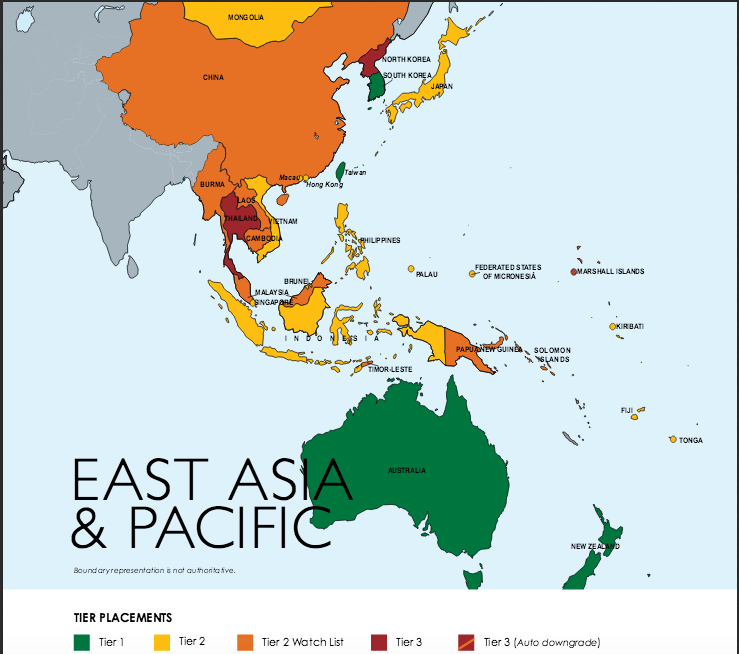
Map: Rating of Anti-Trafficking Efforts East Asia and the Pacific. Source: U.S. Department of State. (2015)
In the late 1800s and early 1900s, the concept of white trafficking began to be recognized by the migration of women from Eastern Europe, who were targeted by traffickers in their search for work. In 1902 between the Hamburg police and the American Immigration Office, 1624 traffickers were identified in Eastern Europe, London, Berlin and Hamburg. An investigation was conducted into the importation and concealment of persons for immoral purposes. Kangaspunta (2016) Since then, there has been a trade in white, European and American women to serve as prostitutes in Arab, African and Asian countries. They realized that kidnapping and deception tactics were used on vulnerable women, and then sexually exploited them. (Ezeta, 2006, 69)
In 1910, 13 countries signed the International Convention for the Suppression of the White Slave Trade, and committees for the suppression of trafficking began to be created in many European countries. However, the world wars interrupted the development of international anti-trafficking work at that time, and it was not until 1949 that the United Nations General Assembly approved the Convention for the Suppression of the Traffic in Persons and the Exploitation of Prostitution. In 2012,
I had the opportunity to attend a seminar on the Global Sex Market, in the Netherlands. I spent three months in Europe studying the problem and participating in prevention and intervention projects. For two months I attended classes in the red light district of Amsterdam. Known as a tourist attraction, this district is built around historic churches that are more than 500 years old, and countless prostitution venues. Advertisements with pornography, sex toy shops, swinger joints and live sex theaters are common in this district. The most shocking thing was to see half-naked women behind the windows in these premises.
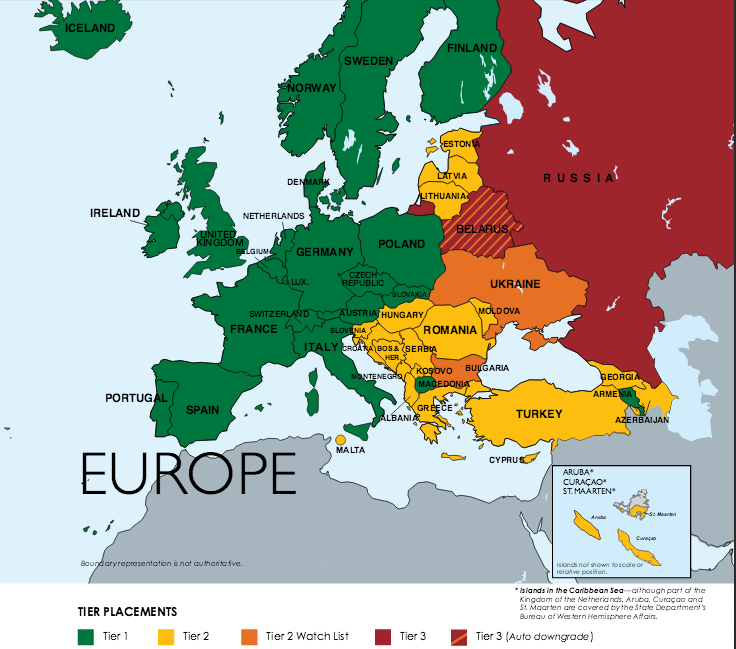
Map: Rating of anti-trafficking efforts in Europe. Source: U.S. Department of State. (2015)
I had never seen the human being in such a graphic way as a commodity on display. Prostitution in the Netherlands was legalized, so that the government could gain more control over crime related to this problem.
However, as discussed on the U.S. State Report website, where prostitution is legalized or tolerated, there is a greater demand for victims of human trafficking and almost always an increase in women and children trafficked for commercial sexual exploitation.
In the newspaper, Le Monde Diplomatique, Marie-Victoire Louis (2006) writes, “Legalized pimping, Dutch style, since 80% of prostitutes in Amsterdam are foreigners and 70% have no immigration status. Suggesting that they are victims of trafficking.
We also found that many of these women had tattoos, which were signs of ownership by the pimps, indicating that they had control over them. They had to pay high costs for the rent of the showcase and premises and work two shifts a day, the shifts consisted of six in the morning to two in the afternoon, from two in the afternoon to ten at night, from ten at night to six in the morning. We also heard of a case, of a girl who committed suicide, when she ran out of the premises and drowned in the canal that was in front.
With this we realized that the prostitution that was practiced in this district was not necessarily of their own volition, and that there were pimps who benefited from the prostitution of these women.
Within the problem discussed in the seminar, the phenomenon of “lover boys” was discussed, these are men who fall in love with their victims. These are mostly teenagers who come from dysfunctional families, who are madly in love with these men and willing to prostitute themselves to please their boyfriends.
The phenomenon of pimp boyfriends was common among Dutch girls prostituting themselves, although cases were also identified where these boyfriends were in the countries of origin of those foreigners and deceived them with promises of work in restaurants, as nannies or in cleaning jobs.
They were in charge of getting them passports and false documentation and when they arrived at the destination they were sexually abused, beaten and prostituted. In the big cities of Western Europe. These pimps known as “lover boys” profit from the prostitution of these girls and keep them in a cycle of manipulation and emotional dependence. In the practical phase of the course we traveled to the city of Riga, Latvia, a Baltic country, which was part of the Soviet Union. Its history was evident in the buildings, most of which were old and it seemed that they had not been intervened in many years; I had the impression that time had not passed in parts of the city. Apart from the cold, I also noticed the older adults with a great feeling of depression and a sad countenance. This was most likely due to the invasion they suffered from the Russian Red Army, which occupied the Baltic countries under the communist regime. The Nazis also invaded “culminating in the Holocaust in the Baltic lands.” “Occupation of the Baltic Republics” (2016) I felt in general a very hurt and resigned culture. There is a great problem of poverty, unemployment, gender inequality and sexual abuse.
Thus, there is evidence of a great problem of human trafficking on the rise in Latvia, mostly adolescent women, with false promises of marriage, coming from low-income families. “The recruiter is usually a friend, a relative, or an acquaintance.” (…) “Knowing that it is someone we know, we trust them, but we never know how real the promises of our relatives are, there are many cases like this, where friends force other friends to leave the country, because a recruiter threatens the safety of their families. In one case, a girl deceived into a fictitious marriage to a foreigner could not flee until she had recruited another girl from Latvia, with a fictitious marriage certificate.” Patvērums (2013) Latvian women are frequently treated in England, Ireland, and the Netherlands.
In Italy, prostitution services are legal, but they are not regulated. It is illegal to pay for sexual services since they cannot give them receipts or pay taxes. Girls are not prosecuted for this. I saw on several occasions the police chasing the cars that passed in front of the girls and some arrests.
These Nigerian mafias operate from their country, in Maghnia, on the border between Algeria and Morocco, and transfer their criminal businesses to Spain. There are several routes passing through Mauritania, towards Morocco and Algeria, reaching the Spanish and Italian coasts crossing the Mediterranean, under the contro
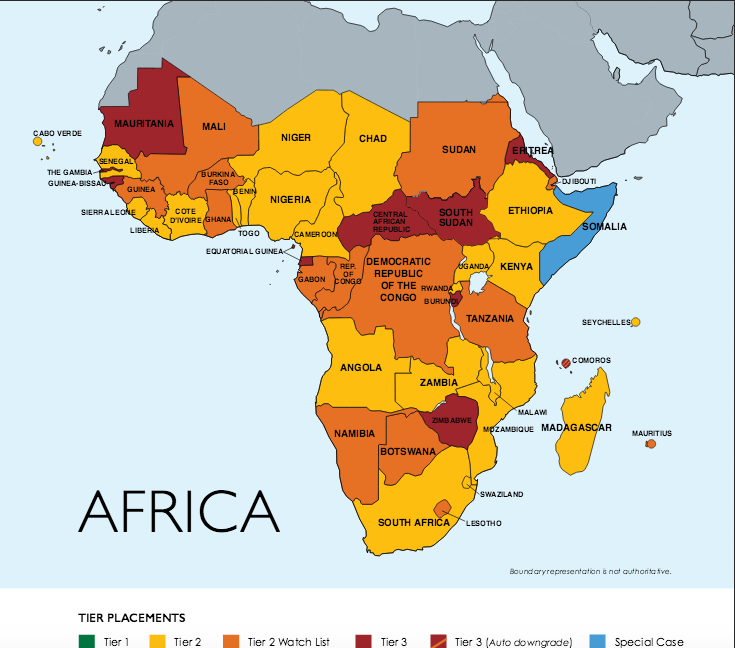
Map: Africa Anti-Trafficking Efforts Rating Source: U.S. Department of State.2015
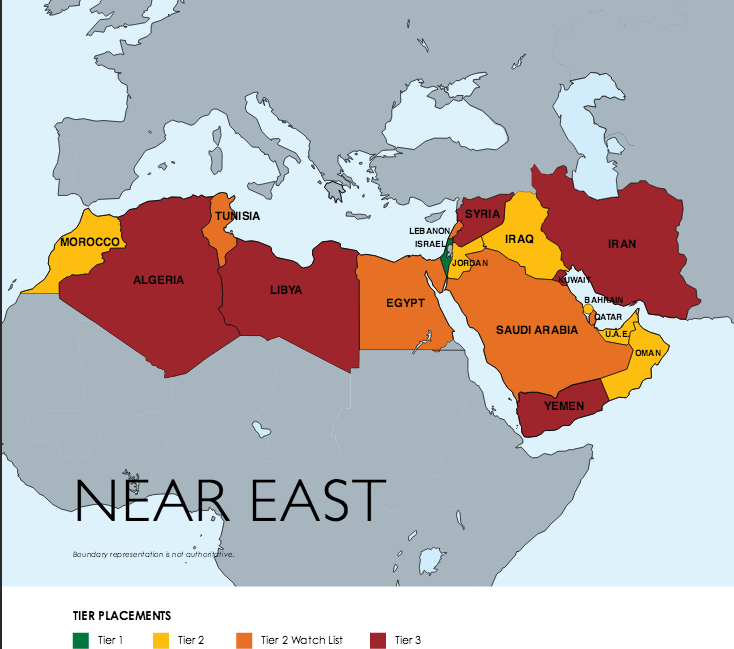
Map: rating of Middle East anti-trafficking efforts Source: U.S. Department of State.2015
Being more aware of the global problem of human trafficking, I found myself more observant of my environment of the history and cultural or religious elements that made Latin America a region of origin for victims. In both Holland and Italy, I identified Latin American people in prostitution, especially from the Dominican Republic; However, something that caught my attention was the fact that the transvestites I met in these two cities were all Latin American.
Just before the World Cup I received an invitation to participate in the same seminar I attended in Holland; for the first time it was going to be held in Latin America, this time in Brazil. I spent six months participating in anti-trafficking projects before and during the World Cup. I also received several trainings because the phenomenon of prostitution and human trafficking had a different nuance with respect to what was studied in the Netherlands, Brazil being a country of origin.
I was surprised when I arrived at the Fortaleza airport, as there were several signs indicating the human trafficking office, because according to the newspaper The Guardian (2013), Fortaleza is recognized as the main center of prostitution, the capital of child prostitution in Brazil. Evidently, I heard stories of those who had been treated to other cities from Brazil, such as countries in Europe.
Shortly after arriving, Carnival was celebrated , this celebration, which seemed harmless to many, becomes permissive for the commercial sexual exploitation of men, children and women.
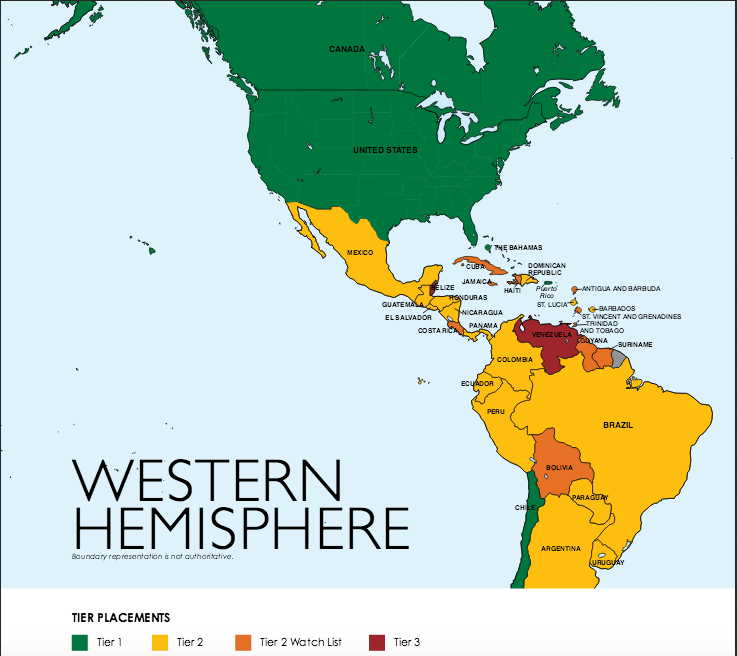
Map: rating of anti-trafficking efforts in the Western Hemisphere. Source: U.S. Department of State. (2015)
The meat festival is typified as an erotic universe, where any prohibition or social norm is disregarded. Fraim (2014)
I was extremely impressed to see 11, 12 year old girls on the corners of the city waiting for customers, who were quite drunk and aggressive before a celebration of more than a week. Police and adults passed by who simply saw the girls without any intervention.
One of these girls was inconsolably crying in a bank because a foreign customer did not want to pay her, after having provided the service. On another occasion a customer reported the girls for theft; however, they argued that they had not stolen anything, that he simply reported them to avoid paying and in the same way, these girls were detained, when the real criminal was the client, for having sexual relations with minors.
UNICEF estimates that this is a five-fold increase from 2001, when 1,000,000 children worked in the sex industry. Children are prostituted in their homes, in tourist areas, in hotels, on highways and in brothels. Fraim (2013)
Another factor to consider is the connotation given to Latin women, by marketing campaigns or the tourism industry, which include Latin women as a stereotype of sensuality and availability.
The macho culture creates an environment where women are devalued and men believe they have the right and authority to attack them. There is talk of an increase in domestic violence during soccer matches. According to the Minister of the Status of Women in Costa Rica, “It has been determined that after soccer matches, many men take out their anger against women” CR today (2015)
Apart from football fanaticism, these events cause a demand for sexual services as part of the celebration. According to The Guardian, there was great fear among officials and people organizing World Cup campaigns about the increase in child prostitution, and pimps recruiting children to meet the demand of foreign and local fans.
While the government spent billions of reais on stadiums, transportation, and other infrastructure, very little was spent on campaigns against the sexual exploitation of minors. The Guardian (2013)
Shortly after arriving, Carnival was celebrated , this celebration, which seemed harmless to many, becomes permissive for the commercial sexual exploitation of men, children and women.
The reality of legalized prostitution in Latin America demands men, women and children for sexual services, and increases the sexual market.
There are mega-brothels with hundreds of men and women available for sexual services. He made two weekly visits to them, in the red light district of the city of Belo Horizonte. They were up to five stories, with narrow corridors, red lights, dirty, small rooms, with half-naked people at the doors who rented the room at a high price.
One night, while I was making these visits; A woman was brutally raped by a man, and she turned to us for support, to help her get out of the brothel with all her belongings, because these people live and work in the same room. We managed to get her to a shelter that night.
Their stories betrayed a whole background of family dysfunction, child sexual abuse, domestic violence and emotional codependency with their partners.
Most had moved from states in the interior of Brazil, to work during the time of the World Cup, all at risk of falling prey to trafficking networks, since now in Belo Horizonte they had a greater risk of being transferred to European countries.
According to the U.S. State of the Year Report, Costa Rica was among the 18 countries with downgrade ratings, now placed on the level 2 watch list. This level is only one level away from 3, which is the lowest. Penalties for countries in Tier 3 may include restrictions on non-humanitarian assistance and funding.
Below are relevant data from this report:
-“Costa Rican women and children are trafficked for the purpose of commercial sexual exploitation in the country, authorities have identified adults who use children to transport or sell drugs; these children can be victims of trafficking.”
– With respect to trafficking for the purpose of commercial sexual exploitation, vulnerable transgender people are identified, as well as women and girls from Nicaragua, the Dominican Republic, and other Latin American countries.
– Child sexual exploitation in tourism is a serious problem, with sex tourists mostly coming from the United States and Europe.” This report reports on government officials under investigation for their alleged involvement in sex trafficking.
– Police and non-governmental organizations noted that services for victims were virtually non-existent outside the capital
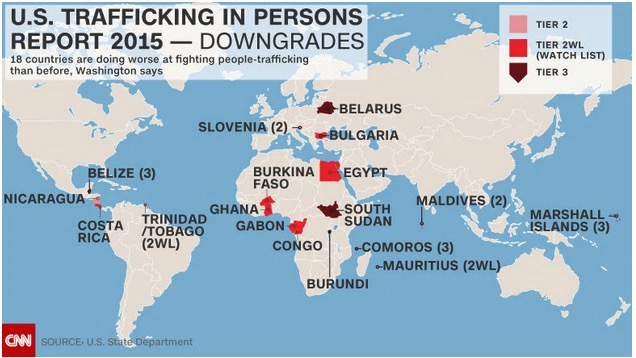
Map: 2015 Human Trafficking Report, downgrades Source: CNN. According to Washington, 18 countries have worsened. compared to last year
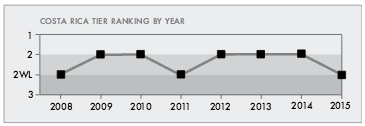
Rating of levels for Costa Rica, per year. Source: Department of State.
n 2014, the government allocated about 73 million colones ($135,000) to cover basic needs such as food, clothing, and travel expenses for victims participating in legal proceedings as witnesses, but it is unclear whether the victims benefited from these resources, as no new cases were brought to trial.
-Victims had the legal right to file a civil lawsuit to seek compensation from traffickers, but no victims received such compensation.
By knowing the reality of those socially ignored, we will be able to understand our environment and the different manifestations that it entails. We then learn that their realities are not alien to ours, because we live with them. This expression is represented in Costa Rican literature. The great actors in our narrative are those whose dignity is threatened and destroyed by exploiters.
“The dispossessed who suffer in the city, the exploited in the countryside, the workers and construction workers who work for poverty wages, the foreign workers who come to become cheap labor because the exploiters who own factories and companies see them as maquila and subject them to inhumane hours with ridiculous wages. They are the propitious characters for a literature that does not ignore the theme of misery, poverty, disenchantment as manifestations of a space closer to what we could call our current reality.” Alvarado (2009)
By knowing the reality of those socially ignored, we will be able to understand our environment and the different manifestations that it entails. We then learn that their realities are not alien to ours, because we live with them. This expression is represented in Costa Rican literature. The great actors in our narrative are those whose dignity is threatened and destroyed by exploiters.
Since 1900 with the work “Las Hijas del Campo” by García Monge, it is appreciated how the theme of prostitution was developed.
This work shows the transition from the countryside to the city and how its protagonists are affected by perversion and vices. Literature as a tool to become aware, as it relates “the clear reality of the time and what happened to the ignorant and innocent daughters of the countryside, when they went to the city and were devoured by it”. Alvarado (2009)
Turning his eyes to Casilda, he pity her very sincerely and extended his compassion to himself, to his circle, to his working class, to the people, and above all, to that group of daughters of the countryside, who daily flock, for very varied reasons, to the capital, who are pitifully corrupted, grow old, taking beggars and abortifacients and considered, how much better it would be for Costa Rica, if instead of the withering away of its robust feminine elements, we saw in them the fertile, vigorous mothers, the rich seed of its desirable historical moment, with a race, with a healthy people, with a courageous, elevated, thinking, active youth; with a robust youth like the Greeks, austere like that of Rome, proud and terrible like that of Poland; with an admirable generation, of those who are the splendor of nations, the defense of law, the most beloved reality of the peoples: of those that, by the way, the afflicted and withered, almost barren Homeland, for its salvation it absolutely needs”
García Monge (1910).
This is how García Monge (1910) relates the attitude of an alien and indifferent world in the face of its misfortunes and sufferings. In her work, the argument of the macho thought, with little morality and a profound degree of dehumanization, of those great lords towards lower-class women is exposed, an attitude that still permeates the current Costa Rican reality.
You can see, the existence since then, of a cold and calculating thought, the man was not going to take care of Casilda’s pregnancy, she would have prostitution as the only way out. This happened to peasant women who were deceived by these lords.
Impunity is evident, since these men, due to their economic power, were allowed to rape and deceive the girls without suffering any consequences.
This harsh reality is exemplified by the stories of many girls, known in the visits made by the Face of Justice Organization on Tuesday and Friday nights in the streets of San José.
Fourteen-year-old girls tell how men with a lot of money and fine cars, some with photos on billboards and advertisements, seek them out for sex. Some men offer more money for not using a condom. On one occasion, one of these girls shared her concern about being pregnant and having been infected with AIDS.
They are popularly called “tierrosas”, girls between 12 and 18 years old, of low resources, from a marginal neighborhood, who resort to prostitution or pornography to receive an income. Some men use this term to denote their preference for these girls for sexual acts. This word is mainly used to devalue, offend and pigeonhole women, an act tolerated in a macho culture.
Concern about such a problem arises in a society that tolerates such behavior. The authorities attribute the problem of prostitution and pedophilia mainly to the sex tourists who visit the country, but this position covers up a latent cultural phenomenon in Costa Rican society, machismo is protected even by the mothers of these men who abuse and assault women. For this reason, Costa Rica attracts and welcomes sex tourists, who give remuneration to taxi drivers, bartenders,and pimps, when they help them in their purposes.
Machismo and pedophilia are rooted in Costa Rican culture, but they are accepted and silenced. When an entire culture is complicit, it becomes extremely difficult to point out the aberrant habits of those who abuse children. When an entire culture is manipulated to maintain silence, exploiters are tolerated, who continue to be the great lords with great economic power, often public figures, as has been manifested by teenagers known in the streets.
Therefore, the problem is not necessarily due to sex tourists, but to a permissive culture that allows the abuse of its children by its own citizens. It should be noted that the campaigns about having sex with minors is a crime in Costa Rica, are in English and are aimed at foreigners, but if awareness is raised they should also be directed at locals, because it is not only a problem related to foreigners.
It is necessary to become aware, for Costa Ricans to remove the blindfold, so that they can see those who suffer from their ignorance and silence. When denial is eliminated and responsibility is taken in defense of the most vulnerable people, it will be possible to take an adequate position to eradicate pedophilia, prostitution and human trafficking in Costa Rican society.
Even if it hurts and I choke,
I AM LATIN AMERICA
The breeze, the palm, the sun.
Scent of flowers,
green colors.
The mountain, the river and the sea.
I carry the tropics in my soul,
The warm morning,
The warm rain on my face.
The taste of salt water.
The vibrant color that embraces me.
Who dares to call us poor?
Why do we believe them ignorantly?
and let them take it all?
I am the gold that remains in my land; the one they want to take by force.
With new imperialist tactics they want to plunder us.
To leave us with nothing in the end.
Our so-called protectors continue to sell us,
denying that such sex tourism exists.
and ignorant their children who do not see reality,
exchanging gold for mirrors, those lies that sink us further.
Well, money comes and goes, they want to sell us what is already ours.
I CARRY THE PAIN IN MY CHEST, FROM THE BLOOD
THAT CRIES OUT IN THE FACE OF SO MUCH INJUSTICE…
I DO REPRESENT LATIN AMERICAN WOMEN!
THE ONE WHO HAS BEEN MISTREATED
The one who dances to the rhythm of the drums and is betrayed by her hips.
Because of its curves they lock it up and put it on display.
As an exotic creature it is sold to the highest bidder.
Without asking permission they take her to distant lands,
exporting it as one more fruit, of this my land.
Oh, I want to run away, I want to get out of here!
But I carry you inside
Latin America I can’t get rid of you.
Until when, oh Latin woman, will you stop being a simple object?
When will you be able to dance in freedom without this being a seductive or sensual dance?
When will you leave the poverty mentality,
to sell your soul for nothing?
Where is your zeal and your power, the commotion of your bowels and your pity towards me?
But the day of vengeance is in his heart. The year of his redeemed has arrived!
His arm saves us, and his anger sustains us, for it is surprising that there is no one to intervene.
Bible, Isa.63:4
© 2025 | Karina Monge Designs. All Rights Reserved.
Designed with 🤍 by Priyash Kadu
WhatsApp us